“Klänge des Friedens!?” [Sounds of peace!?”] – Lecture by Dieter Senghaas

Under the title “Sounds of Peace” the internationally renowned peace, conflict and development researcher Prof. em. Dr. Dr. Dieter Senghaas (University of Bremen) worked out a a capital, trend-setting presentation for the PROJEKTINSEL HARTMANN-NONO as part of the “Karl Amadeus Hartmann Year 2013” (2012–2014).

The question will be explored to what extent art as a so-called “soft indicator” can contribute to de-escalation or, as an early warning, draw attention to impending undesirable developments in a society’s mental budget.

Especially composers like Hartmann, who are sensitive to socio-political grievances, who use seismographic antennas to perceive developments that are not yet obvious, to detect their potentially fatal dynamics and to deal with them in their art, are particularly suited to this task. Research speaks of the ability of “early warning”.

Years before 1933, Hartmann had already warned in every possible way of the danger of National Socialism for society, humanity and humanism. In each work he dealt with this in a different way, invoking resistance in alliances between cultures, religions and peoples; he pointed out alternatives, drew a different world view. It is also astonishing that in his last work, the “Gesangsszene” for baritone and orchestra, he once again demonstrated the ability of “early warning”: assimilating texts by Jean Giraudoux, he conveys an apocalyptic vision of the end of a civilization drawn into a spiral of death.

The initial dynamic of progress does not only turn into regression, but into decline, into the “evil of the great empires, the deadly evil”. Downfall of the banking world, social structures, nuclear disaster, war and the most deadly evil: that even the “treasure of souls” is lost. The lecture was held on March 20, 2013 in the Munich Stadtmuseum.

Read the complete lecture under the menu item “Musicological publications” here in the Archival holdings!

Interesting new CD releases at Challenge Records

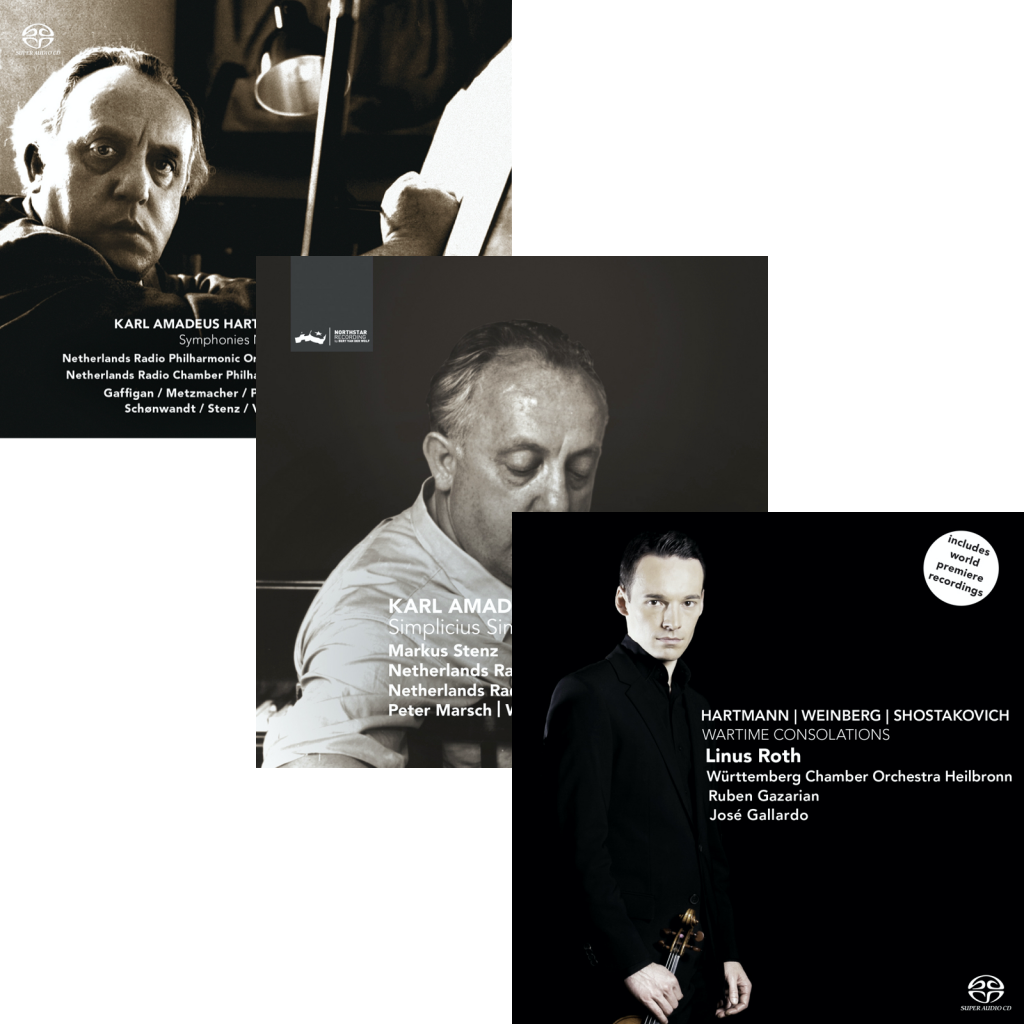
The deserving Dutch label Challenge Classics has ensured that the Hartmann discography has been enriched by some significant contributions.

A new complete recording of Hartmann’s eight symphonies with the Netherlands Radio Philharmonic was released in early 2014. These are live recordings under the direction of conductors Ingo Metzmacher, Christoph Poppen, Michael Schönwandt, Markus Stenz, Osmo Vänskä and James Gaffigan – on three SACDs. The FONO FORUM spoke of a “new reference” in view of the consistently outstanding artistic and tonal quality of the recordings.

More at Challenge Records

More at jpc

A new recording of Hartmann’s opera “Simplicius Simplicissimus” (in the revised version of 1957) was also made with the Netherlands Radio Philharmonic. The title role is sung by Juliane Banse, Markus Stenz stands at the podium of the orchestra. This recording is based on a live performance on November 24, 2012 at the Concertgebouw Amsterdam.

More at Challenge Records

More at jpc

Finally, violinist Linus Roth presents his interpretation of the “Concerto funebre” on Challenge Classics – coupled with works by Mieczyslaw Weinberg as well as the first recording of an unfinished violin sonata by Dmitri Shostakovich.

More at Challenge Records

More at jpc

YouTube interview with Linus Roth about this CD

Karl Amadeus Hartmann goes to Kiev

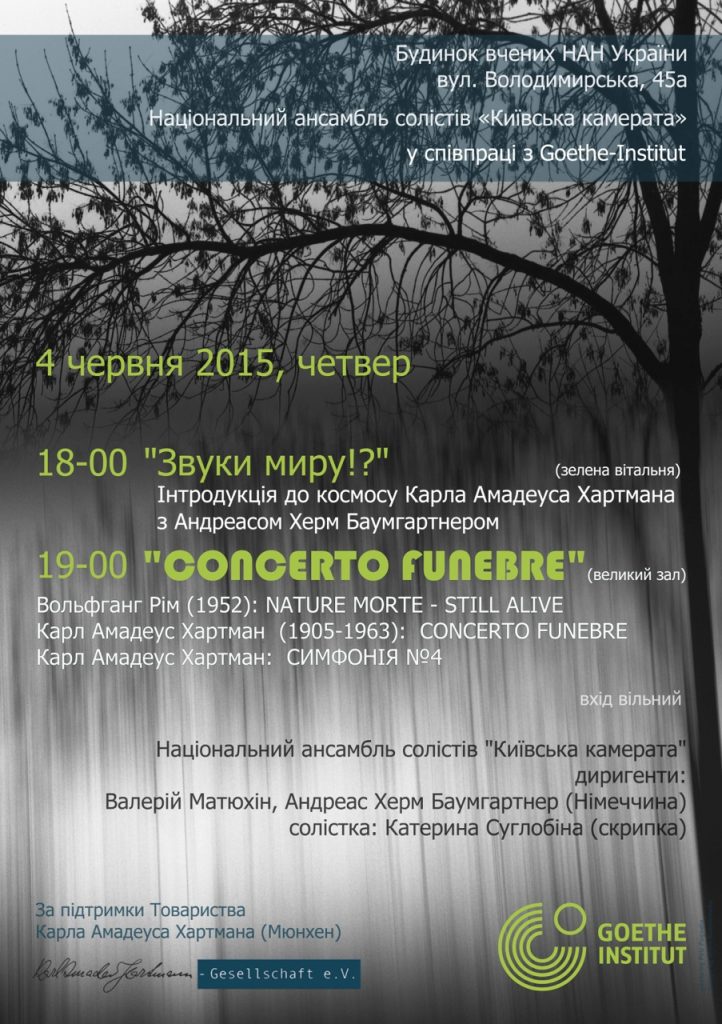
In cooperation with the Ukrainian State Orchestra Kyiv Kamerata, the Goehte Institute Ukraine, the Kiev Summer Music Festival, the Composers’ Association Ukraine and the Karl Amadeus Hartmann-Gesellschaft e.V., a concert with works by Karl Amadeus Hartmann and Wolfgang Rihm will take place on June 4, 2015 in the concert hall of the Academy of Sciences in Kiev (Ukraine).

Together with the chief conductor and artistic director of Kyiv Kamerata Valeriy Matyukhin, the conductor and director of the Karl Amadeus Hartmann-Gesellschaft e.V. Andreas Hérm Baumgartner – on whose initiative the project came into being – will conduct this concert, which is special in every respect: an act of solidarity, a sign of solidarity in an existentially threatening political situation in which Hartmann’s music with its message of humanism cannot be missing. In an accompanying introductory event with the theme “Klänge des Friedens” [“Sounds of peace”] the question of what music can do, what should music and art be able to achieve, will be explored.

Current development, conflict and peace research also deals with this topic. Especially with composers like Hartmann, who have a sensibility for socio-political grievances, who use seismographic antennas to perceive developments that are not yet obvious, track down their potentially fatal dynamics and deal with them in their art. Research speaks of the ability of “early warning”. Years before 1933, Hartmann had already warned in every possible way of the danger of National Socialism for society, humanity and humanism.

In each work he dealt with this in a different way, invoking resistance in alliances between cultures, religions and peoples; he pointed out alternatives, drew a different world view. It is also astonishing that in his last work – the “vocal scene” for baritone and orchestra – he once again demonstrated the ability of “early warning”: assimilating texts by Jean Giraudoux, he conveys an apocalyptic vision of the end of a civilization drawn into by a spiral of death. The initial dynamic of progress does not only turn into regression, but into decline, into the “evil of the great empires, the deadly evil”. Downfall of the banking world, social structures, nuclear catastrophe and the deadliest evil: that even the “Seelenschatz” [“Treasure of soul”] is lost. An unfortunately all too topical subject.

PROGRAM
Wolfgang Rihm: nature morte – still alive

Karl Amadeus Hartmann:
Concerto funebre
4th Symphony

Katya Suglobina, Violin
Kyiv Kamerata
Direction: Valeriy Matyukhin, Andreas Hérm Baumgartner

Success for Hartmann’s “Gesangsszene”

In April 2015, Christian Gerhaher and Kirill Petrenko performed Karl Amadeus Hartmann’s “Gesangsszene” with the Bavarian State Orchestra in Munich, Budapest and Vienna.

Here is an overview of the echo in the press landscape:

Süddeutsche Zeitung, April 14

Süddeutsche Zeitung, April 24

Abendzeitung München, April 15

Die Presse, Wien, April 21

Kurier (Vienna), April 21

Der Standard (Vienna), April 22

Wiener Zeitung, April 28

Kleine Zeitung (Vienna), April 28

New Management Board

PRESS RELEASE (originally in German)

Munich (February 6, 2015)

The General Assembly of the Karl-Amadeus-Hartmann-Gesellschaft e. V. elected a new Board of Directors on December 16, 2014. Under the chairmanship of the confirmed managing director Andreas Hérm Baumgartner (conductor, artistic director), the conductor Christoph Poppen was elected president. Appointed to the board were the musicologist Prof. Dr. Wolfgang Rathert (LMU-Munich) as deputy managing director, the lawyer Andreas Ammersbach as treasurer and the musicologist Thomas Schulz as secretary/media director.

The members of the Karl Amadeus Hartmann Society include not only music lovers and scholars, but above all personalities from national and international cultural life, including Helmut Lachenmann, Wolfgang Rihm, Jörg Widmann, Udo Zimmermann, Friedrich Cerha, Fabio Luisi, Ingo Metzmacher, Marek Janowski, Kurt Masur, Thomas Zehetmair, Ingolf Turban, Siegfried Mauser and Reinhold Kreile.

The central task of the Karl Amadeus Hartmann Society is to promote the dissemination and understanding of the composer’s works and to be a forum for his person and his work. This is done on the one hand by collecting and archiving material from and about Hartmann, by making his work and biography scientifically accessible, and by making the archive material available to performers, scholars and interested parties. Not only are scientific papers and publications supervised and edited, but also new ways of teaching are taken, e. g. through advanced training for prospective music teachers, cooperation with schools and lively education projects that challenge the creativity of the students.
On the other hand, the Hartmann Society also sees itself as a source of inspiration for national and international performances and as an intermediary and connecting link between the management levels of the orchestras/festivals and the performers. It appears both as organizer and co-organizer of concerts, lectures, symposia and exhibitions, nationally and internationally. Especially the international festival “Karl-Amadeus-Hartmann Year 2013” (seasons 2012/13 and 2013/14), for which Andreas Hérm Baumgartner was responsible as Artistic Director and which has attracted attention everywhere, succeeded in paying tribute to the most important German-speaking symphonist of the 20th century and founder of the musica viva concert series of the Bavarian Radio on the 50th anniversary of his death. The festival gave new impulses in the examination of the composer’s œuvre with more than 140 concerts, exhibitions, panel discussions and symposia worldwide. Artistically high-ranking orchestras and interpreters of world class could be involved: The London Philharmonic Orchestra, Symphonieorchester des Bayerischen Rundfunks, Orchestre de Paris, Philharmonia Zürich, Rundfunkorchester Berlin, American Symphony Orchestra, BBC Symphony Orchestra, Netherlands Radio Philharmonic Orchestra as well as Patricia Kopatchinskaja, Isabelle Faust, Thomas Zehetmair, Reto Bieri, Matthias Goerne, Juliane Banse, Kent Nagano, Fabio Luisi, Markus Stenz, Ingo Metzmacher, James Gaffigan and Vladimir Jurowski are just a few examples.
The field of activity of the Hartmann Society is completed by exhibitions that are not only dedicated to aspects of Karl Amadeus Hartmann’s life and work, but also feel particularly committed to the intellectual, artistic, social and socio-political heritage of the composer. The current special exhibition „In Liebe …. auf ewig?“ [“In love … forever?”] is based on the correspondence of the married couple Elisabeth and Karl Amadeus Hartmann and covers the period from 1931 to 1945, i. e. precisely the years that have had such a decisive influence on Hartmann’s life and musical language. This correspondence describes intensely and relentlessly how a young artist fared during this time resisting the seductions of the Nazi regime and offering opposition in many ways. A tour of the permanent and the special exhibition is possible by appointment from Tuesday to Thursday (10 to 12 AM and 2 to 5 PM).

Contact:

Karl-Amadeus-Hartmann-Gesellschaft e.V.
Franz-Joseph-Straße 20
D-80801 Munich

Tel.: +49 (0)89 34 79 67

Fax: +49 (0) 3212 1357 315

E-mail: info@hartmann-gesellschaft.de

Agenda items of the general meeting 2011

Agenda:

Ordinary General Meeting 2011

On December 9, 2011, 4:30 p.m.

  1. Welcome
  2. Report of the Management Board on the situation of the society
  3. Report of the treasurer about the business year 2010
  4. Auditor’s report on the 2009 financial year
  5. Discharge of the Management Board
  6. Election of the auditor for 2010
  7. Short review of the activities of the company in 2011
  8. “Karl-Amadeus-Hartmann-Jahr 2013” [“Karl Amadeus Hartmann Year 2013”]
  9. Other (e. g. concerns, suggestions from members, open discussion)

The Managment Board reserves the right to make any changes or additions.

Andreas Hérm Baumgartner
Managing Director of the Karl Amadeus Hartmann Society

Patronage of Minister of State Dr. Wolfgang Heubisch for the Hartmann Year 2013

We have succeeded in winning Minister of State Dr. Wolfgang Heubisch as patron of the Karl Amadeus Hartmann Year 2013!

We would also like to express our sincere thanks through this medium. This is a very important signal from the Free State of Bavaria, which also expresses the importance of the composer in Bavaria.

With the support of the State Ministry of Science, Research and Art, the Karl Amadeus Hartmann-Gesellschaft e.V. tries to initiate and coordinate a wide variety of events, concerts, exhibitions etc. Furthermore, for the first time, scientific papers on specific themes from Hartmann’s work are to be awarded.

Karl Amadeus Hartmann Year 2013

2013 marks the 50th anniversary of Karl Amadeus Hartmann’s death and the music world will pay tribute to this grand composer.

The Bavarian State Ministry for Science, Research and Art has therefore decided to proclaim a “Karl Amadeus Hartmann Year 2013”.

Minister of State Dr. Wolfgang Heubisch will assume the patronage.

The Karl-Amadeus-Hartmann-Gesellschaft e.V. acts as initiator, intermediary, source of inspiration and organizer.

The artistic director of the festival is the conductor Andreas Hérm Baumgartner.

“Weltmusikfestival Grenzenlos: Herausragende Leistung im fast leeren Saal” [“World Music Festival Without Borders: Outstanding performance in an almost empty hall”]

From: Merkur (October 27, 2010)

Source (originally in German): http://www.merkur-online.de/lokales/murnau/weltmusikfestival-grenzenlos-herausragende-leistung-fast-leeren-saal-973150.html

Murnau – freedom as conscious attention to the fate of individual people. This is the ambitious theme of the world music festival Grenzenlos 2010. It started with a special concert. (© AUTO_MUR)

Two professionals who understand each other: Conductor Andreas Hérm Baumgartner and first violinist Jeany Park of the Bavarian Philharmonic Chamber Orchestra. Few have heard the moving performance of the works of the anti-fascist composer Karl Amadeus Hartmann. Photo: kolb

In his speech at the opening of the festival, Michael Rapp, Mayor of Murnau, made it clear that freedom only comes into consciousness through the personal experience of the opposite: being locked in. The critical impulses of the comprehensive topic of “boundlessly free” required a high degree of tolerance, which the Murnau Cultural Association, namely the chairmen Thomas Köthe and Konstantin Zeitler, would take up in an exemplary manner.

But disappointment prevailed on the first evening of the festival, which lasts until tomorrow’s Sunday: the chamber orchestra of the Bavarian Symphony Orchestra played in front of an almost empty hall. Almost 60 listeners do not do justice to the anti-fascist composer Karl Amadeus Hartmann. The concert was a moving homage to the Munich composer whose work, buried in the parish garden of the Christuskirche (we reported), survived the Nazi regime.

The chamber orchestra had an excellent leader in Andreas Hérm Baumgartner. The conductor preceded Hartmann’s 4th Symphony with a specially written orchestral version of Franz Schubert’s string quartet “Der Tod und das Mädchen”. With this variety of violins, the inner drama of the late work came to the fore even more clearly. Baumgartner focused on the colouring and description of sound forms. In the large version for orchestra, the death motif of sound repetition showed a similarity to the idea in Ludwig van Beethoven’s 7th Symphony. Through the superimposition of the string parts, the unconditional nearness of death spread almost palpably throughout the hall. If one adds the oppressive stage design by Christian Schied and Bernd Weber to the description – a section of bars over which blurred, faded rows of numbers ghost – then the transition to Hartmann’s work is perfect.

“The Inner Emigrant” is the name of a concert and exhibition (we reported) on the life and work of Karl Amadeus Hartmann. This highly committed, impressive and moving performance with music made clear what life in the Third Reich had actually meant.